

As a freelancer turned business owner, I have always liked doing everything myself, from branding to content creation to marketing. Conceptualizing Grae Content took years of planning and studying until I was happy with the quality of my services and offers.
- SMART Goal Setting
- Applying the SMART Method
- Creating Relevant Short-term Goals
- Measuring Attainability to Set Realistic Expectations
- Update Goals Periodically
Goal-setting is the first step to improving productivity, which provides direction and purpose to your daily tasks and actions. A day without goals is like going to an unknown destination without a map. SMART goal-setting, in particular, helped me become more productive and outline what I wanted out of my time.
This is my guide to goal setting using the SMART method:
SMART Goal Setting
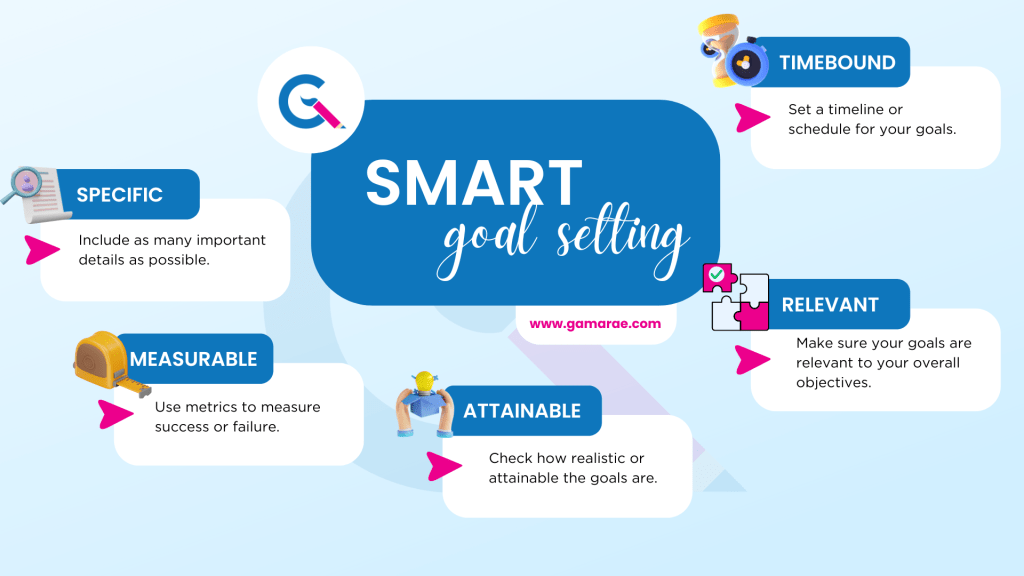
I use the Specific, Measurable, Attainable, Relevant, and Timebound (SMART) method to set my long-term and short-term goals. Many experts have mixed opinions on this process, but it is a practical starting point, especially for beginners.
Of course, you may develop other methods and strategies as you become more comfortable with the underlying principles.
Applying the SMART Method

There are a million goals to choose from, and you should explore what you want. I suggest having goals you are directly responsible for, like financial and health goals, instead of promotions or corporate goals beyond your control. It’s okay to have those, but it is better to focus your resources on the things within your power.
As a freelancer, I had the long-term goal of turning my self-employment into a business. Using the SMART method, I outlined this as a goal: I want to convert my freelance career into Grae Content Digital Marketing Services, a company specializing in branding, content, and digital marketing that sustainably brings in at least a gross income of $10,000 monthly by 2025.
Let’s examine the goal according to its compliance with the SMART method:
- How specific is the goal? It’s straightforward enough: convert self-employment to a sole proprietorship or solo corporation as a full-fledged business.
- How is the endeavor’s success or failure measured? There are several measures: sustainability (consistency), $10,000 monthly (money), and 2025 (timebound).
- How attainable is it? The attainability relies on your willingness to act. You must have proper preparation and actions to match your big goals. We will discuss this in detail in the next section.
- How relevant is my goal? My goal is related to my current efforts. I have been freelancing for almost two decades and have substantial experience in branding, content, and digital marketing. Therefore, my goal is relevant to my current trajectory.
You may argue that 2025 needs to be more specific, which is not a good time measure since there are 365 days in the year. That’s why you need to set both short-term and long-term goals.
As I approach my hypothetical 2025 goal, I would set short-term milestones to ensure I reach the long-term objective.
Creating Relevant Short-term Goals

Of course, the long-term goal was just an example because I am not doing all this for the money. I love helping businesses, and having a platform to share my knowledge is rewarding enough for me because I want to help freelancers and business people succeed.
However, in this post, I want to illustrate how you can outline relevant short-term goals that lead to a more significant long-term pursuit.
These are six short-term goals:
- First half of 2023 – business permits and other compliance documents and earn $1,000 monthly
- Q3 to Q4 2023 – earn $3,000 monthly
- Q1 to Q2 2024 – earn $5,000 monthly
- Q3 to Q4 2024 – earn $7,000 monthly
- Q1 to Q2 2025 – earn $9,000 monthly
- Q3 2025 onwards – earn $10,000 monthly
Now that you’ve broken down your long-term goal into short-term milestones, it’s time to assess their attainability. For this example, I will take a holistic view of my long-term goal and its six corresponding short-term goals.
Measuring Attainability to Set Realistic Expectations

The beauty of goal-setting lies in its ability to turn aspirations into tangible plans. By putting your goals down on paper, you can visualize them and create a roadmap to achieve them. Your goal attainability depends on your current resources, skills, and commitment.
Set realistic and achievable goals while challenging yourself to reach higher. How attainable are the goals I’ve laid out?
My collective goals:
- Long-term: Convert my freelance career into Grae Content Digital Marketing Services, a company specializing in branding, content, and digital marketing that will sustainably bring in at least a gross income of $10,000 monthly by 2025.
- Short-term: Processing business permits and other compliance documents and earning $1,000 monthly by the first half of 2023, earning $3,000 monthly by Q4 2023, earning $5,000 monthly by Q2 2024, earning $7,000 monthly by Q4 2024, earning $9,000 monthly by Q2 2025 and earning $10,000 monthly by Q3 2025.
Self-awareness is crucial for understanding what goals are realistic and achievable. For instance, expecting to earn $10,000 monthly from a full-time job in the Philippines may not be realistic, given the local economic conditions and the job market.
Therefore, in this goal-setting example, I should start the journey by transforming my freelance career into a business, creating more realistic and sustainable revenue opportunities. Doing things myself could result in burnout and fatigue, and sustainability is a big part of the long-term goal.
The short-term goals paced the monthly revenue target to increase by $2,000 every six months until achieving the long-term goal. I would further break these goals into monthly, weekly, and daily efforts, making them more manageable.
Update Goals Periodically

Goal setting is a powerful tool that helps us navigate our journey through life. Like maps, goals provide direction and guidance, helping us stay focused and motivated. However, unlike maps, goals are not set in stone. They can be flexible and adaptable, allowing us to adjust our course as we progress.
For example, if you set a goal to achieve a specific sales target in a year, you might exceed that target in just a few months. Similarly, if you aim to lose 10 kilograms in six months, you might reach that milestone sooner than expected. This flexibility allows us to celebrate our achievements and set new, more ambitious goals.
Goal setting inspires us to push beyond our limits and achieve greatness. By setting clear, achievable goals and remaining flexible in our approach, we can unlock our full potential and achieve our wildest dreams, lest they be specific, measurable, attainable, relevant, and timebound.
Let me know your thoughts and subscribe for more freelance tips and insights.


 Grae Content Digital Marketing Services
Leave a comment